Preparing for exams as a group
Everyone at the table nods along with the explanation, but a new question brings the conversation to a halt. A good group discussion can easily feel like personal mastery. Preparing for exams together becomes more useful when everyone attempts an answer, explains their reasoning and identifies what they need to practise next.
The Aria editorial team · 7 min read · For students who want to use their study group for focused exam preparation.
Group exam preparation works best alongside individual practice. Check what the exam requires, let everyone answer before discussion and compare reasoning against course sources. Finish with specific follow-up tasks and a fresh individual attempt. The aim is not simply agreement within the group, but knowledge each person can use without help from others.
Check what you are preparing for
Start with learning objectives, question formats and information from your course lecturer. A written discussion question calls for something different from an oral explanation or a calculation. Past papers can illustrate a format, but they cannot guarantee what you will be asked. Choose a manageable topic within the syllabus and agree on what a reasonable answer should cover.
For a question about correlation and causation, you might agree that an answer should explain the distinction, use a relevant example and consider a possible third variable. This is a working agreement, not an official marking guide. Where your institution provides assessment criteria, those should carry more weight than the group’s own impression of a good answer.
Give the session a clear endpoint. “We will study psychology” is vague; “we will answer and check one discussion question” makes the work easier to review. Leave other topics for another session rather than revisiting the whole exam schedule every time.
Let everyone try before sharing answers
Ask each person to write a short outline or explain the idea without looking at notes first. Active recall means bringing knowledge to mind yourself rather than reading an available answer. An independent attempt gives you something concrete to discuss and reveals whether someone recognises a term but cannot yet supply an example or justify a claim.
Roediger and Karpicke’s 2006 study examined students learning prose passages. Memory tests led to better delayed recall than repeated reading in parts of the study, although reading could look better in the short term. This supports practice testing, not a claim that any group test improves exam grades. Dunlosky and colleagues’ 2013 review also identifies practice testing and distributed practice as well-supported techniques.
Avoid letting the quickest participant open with the answer, because you then lose sight of what others could work out independently. Everyone should attempt an answer before sharing. If prior knowledge varies, some can tackle a simpler part while others explain an exception or test a more demanding assumption.
Discuss the reasoning, not just the conclusion
Once you have independent answers, ask why they differ. Two people can reach the same conclusion through different reasoning, and both can miss the same condition. Ask the speaker to show how the argument relates to the course material, then let someone else test it against a new example. Settle factual disagreement by consulting the source, not by counting votes.
Smith and colleagues’ 2009 study examined structured discussions of concept questions in an undergraduate genetics course. Students answered individually, discussed and received a new, similar question. The results suggest that discussion can contribute to understanding in that setting. This was not a study of every kind of exam preparation or digital study app, and it does not establish an effect for Aria.
A fresh question matters because repeating the same answer can hide that you only remember the conclusion. Change the example or one of the conditions and see whether the explanation still works. If nobody can resolve a point, record it as an open question for the lecturer or as something the group needs to look up.
A shared direction with independent answers
Aria offers a place for team notes, tasks and conversation. Use the team to coordinate the work while each participant does their own practice. A personal practice exam does not automatically become a shared exam with a combined group grade. You can still discuss the subject matter together where you are allowed to share the material.
This approach combines team coordination with independent answers. You do not all need the same practice set or tools. If your questions differ, choose a common syllabus problem for the discussion.
- Open the team and agree on a topic, an accessible course source and what the question should examine. Record the scope in a team note.
- Let everyone make an independent attempt before discussion. Use your own question or a personal practice exam where that tool is available.
- Compare reasoning in a meeting or the team conversation and check disagreements against the course material. Record conclusions and open questions in the note.
- Create follow-up tasks in the team with an assignee and a deadline. Each participant then makes a fresh individual attempt at what was difficult.
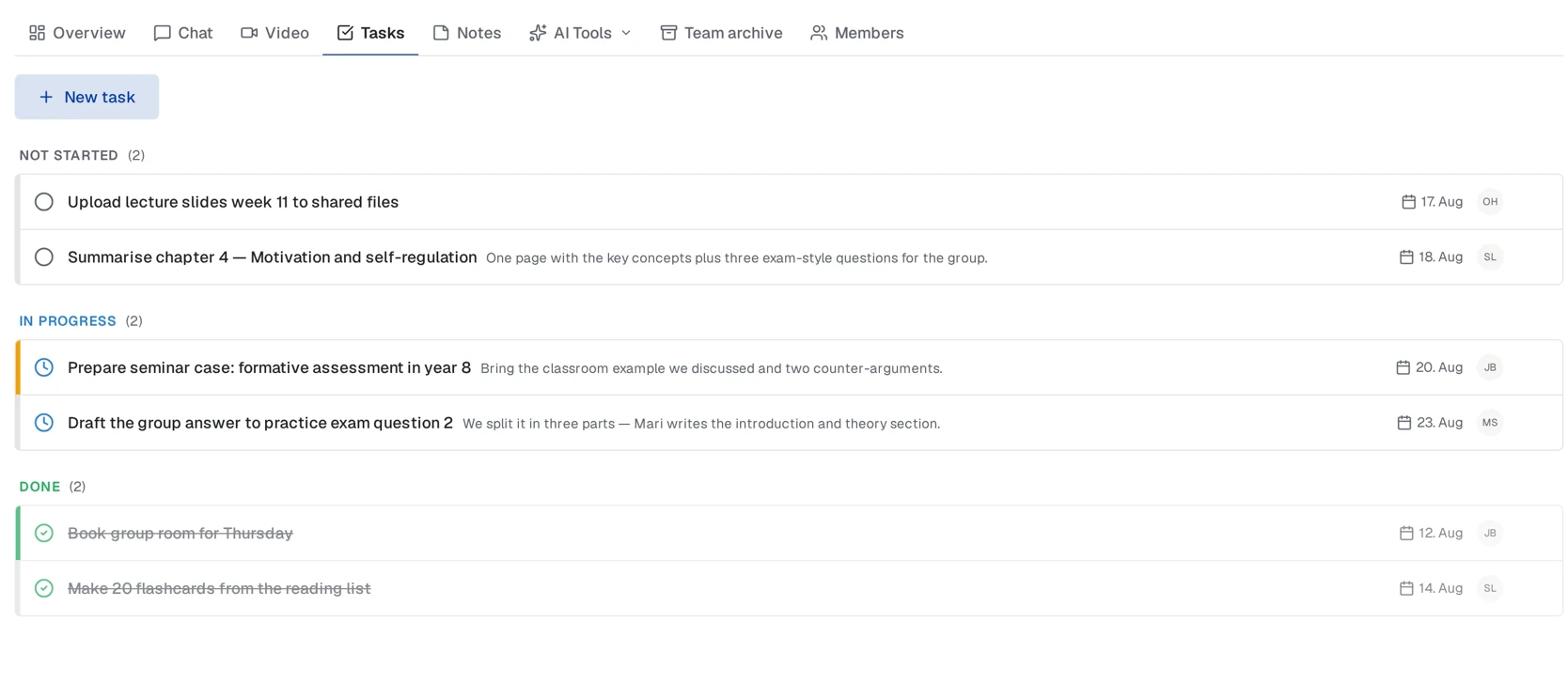
Turn gaps in understanding into the next task
Agree too quickly
- Read a good answer aloud and let everyone nod.
- Choose the most popular explanation without checking a source.
- Finish without agreeing on each person’s next action.
Examine each answer
- Let everyone answer before discussion.
- Compare reasoning and check it against the course material.
- Agree on individual follow-up and try a fresh question.
Record what each person needs to do after the discussion. “Practise more” is hard to follow up; “explain third variables using a fresh example and check chapter 3” describes an action. A team task can have an assignee and a deadline, but ticking it off shows completion of an activity, not mastery of the topic.
Let the next check happen individually after a break, perhaps on a later study day. Attempt a similar question without the group’s notes, then compare with the source. Distributed practice has research support, but no single interval suits every subject or deadline. Agree on realistic follow-up rather than expecting everything to stick after one discussion.
Use the group thoughtfully before the exam
As the exam approaches, the group should help you identify what your own practice has not resolved, rather than fill every available hour. Bring one question you are stuck on and one answer you want checked. Keep time to work alone under the conditions your exam requires, so that help from others does not become an essential part of your answer.
Agree on an endpoint for discussions that are going nowhere. If you lack a source or a crucial premise, it is more honest to mark the uncertainty than write a confident shared conclusion. Respect rules about permitted aids, collaboration and sharing. A study group does not give you permission to collaborate on individual assessed work or distribute restricted exam material.
You do not need to become equally strong in everything or use identical wording. A useful finish is for each person to say what has been resolved, what remains open and what their next independent attempt will involve. The group can provide direction while responsibility for the learning stays with each participant.
Do this now
- Check the question format and assessment requirements for your course.
- Give everyone an independent attempt before sharing answers.
- Check reasoning and disagreements against course sources.
- Agree on individual follow-up and a fresh attempt.
Frequently asked questions
Should we do all our exam practice together?
No. Use the group for discussion and checking, and keep individual practice without help. Independent attempts reveal what you can use on your own.
Can the group take a shared practice exam in Aria?
This article describes personal practice and team coordination, not a shared exam session with combined assessment. Only discuss material you are allowed to share.
What if nobody knows the right answer?
Record what is unclear, consult the relevant course source and ask your lecturer when needed. Agreement without evidence is not an answer key.
How do we handle different levels of knowledge?
Let everyone try independently and adapt the parts of the task. Someone with more knowledge can explain their reasoning, but others still need to formulate their own answers.
Sources
Keep track between study sessions
Use team notes and tasks in Aria to coordinate the group’s work, then continue practising independently. Try the service free for 7 days.
Start 7 days free