How to get more out of your study group
You have set aside an hour for your study group. One person has read the whole chapter, another needs help with the terms, and the conversation starts with what might appear in the exam. By the end, you have spent time together but are unsure what you understand better. A clearer task can change how you use the meeting.
The Aria editorial team · 7 min read · For students who want to use study groups, group chats or online meetings for focused academic work.
A useful study group gives everyone space to think, explain and investigate uncertainties. Choose a specific question, let each person attempt an answer first and compare your reasoning against the course material. Use a shared note for conclusions and open questions, then finish with a clear agreement about the next steps.
Start with something to work out
“We will go through chapter four” says little about what you will actually do. A better starting point might be: “How can we distinguish correlation from causation in this example?” That gives you a question to investigate rather than a pile of pages to mention. Agree on the reading or lecture you will use as your basis too.
Ask everyone to prepare a short answer of their own and one point they are unsure about. It need not be a polished assignment. The aim is for each person to bring something to contribute, including those who find the topic difficult. Having questions before the meeting makes it easier to prioritise what needs discussion.
A practical structure might allow a few minutes for individual answers, a longer discussion and a short conclusion. Adapt the time to the task; this is a suggestion, not a research-based formula with prescribed timings. Keep the first session manageable enough for everyone to explain something.
Ask for reasoning, not just the right answer
If one person gives a convincing explanation and everyone else nods, you still know little about what the others understand. Instead, ask participants what they agree with, what they would challenge and which example demonstrates the point. Differences in understanding become visible without turning the conversation into a competition.
In 2009, Smith and colleagues investigated structured discussions of conceptual questions in a university genetics course. Students answered individually, discussed and answered again; they also received a new individual question on the same concept. The study supports academic discussion in that teaching context, not a guarantee that every study group or online group improves grades.
Chi and colleagues’ 1994 study examined pupils prompted to explain material to themselves while reading about the circulatory system. It concerned individual self-explanation, not group work. Together, these studies offer a rationale for prioritising reasoning and explanations in your own words, but they do not establish an effect for Aria.
Give everyone an independent attempt
Use one specific question before opening the answer. For the correlation example, each person could explain why ice cream sales and drowning incidents might rise together without ice cream causing drowning. Compare the possible explanations you proposed, then check the course material on third variables. This is a constructed example, not a dataset to treat as evidence.
- Explainer: Show how you reached the answer, not just the conclusion.
- Questioner: Ask for an example or identify a missing step.
- Note-taker: Record what you have checked and what remains unresolved.
Rotate roles. The usual note-taker also needs time to answer, while a knowledgeable participant can practise asking useful questions. After the discussion, everyone should attempt a new example alone. Dunlosky and colleagues’ 2013 review supports practice testing as a learning technique; active recall means retrieving knowledge before looking at the answer.
Organise your study group in Aria in four steps
Aria teams include chat, video, notes, shared files and tasks. These tools can bring arrangements and academic follow-up together, but you still choose what to share and what to work on. Personal notes do not automatically become available to the rest of the group.
- Open an existing team, or create one and invite the participants. Agree on a specific academic question and what each person will prepare.
- Use team chat to arrange the time and sources. Choose a team note or shared file that the relevant participants can access.
- Work in the shared note and compare your own answers. Use chat or video to discuss reasoning, and check conclusions against the source.
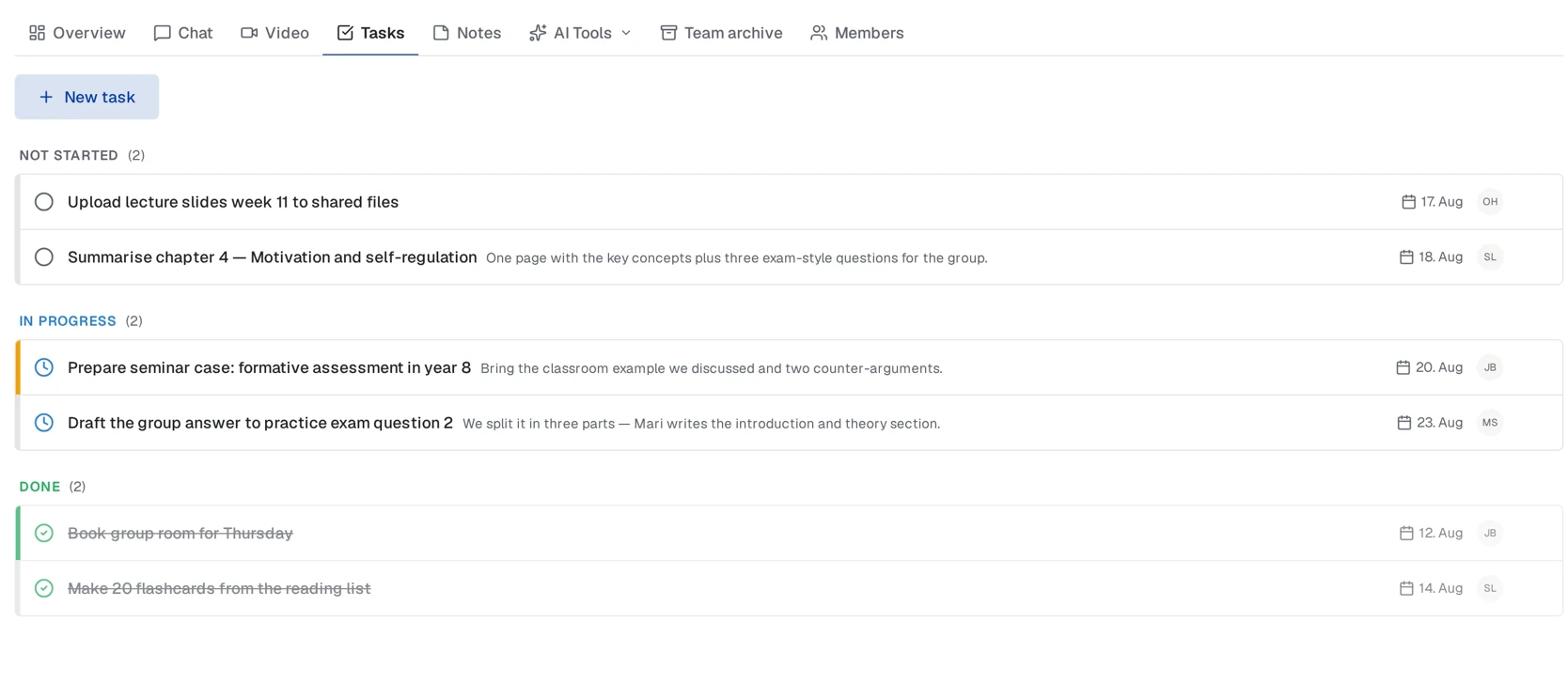
- Record open questions in the note. Create follow-up tasks with an assignee, due date and status, and agree on what to check next time.
Take away more than a long set of minutes
An unstructured review
- One participant reads out a summary.
- Others follow along without trying for themselves.
- The group finishes without deciding what remains.
A focused working session
- Everyone offers an initial answer and reasoning.
- Disagreements are investigated using examples and sources.
- Open questions get an owner and a follow-up.
A short note can be enough: the explanation you settled on, where you checked it and what needs further investigation. Avoid writing that you “know the topic” just because you agreed on a shared wording. The final individual attempt tells you more about where each person still needs work.
In online meetings, recording or transcription is a deliberate choice, not something to assume happens automatically. Check consent and your institution’s rules first. Creating meeting notes from a transcript requires an available transcript and a separate generation action; access depends on the subscription. Read and check the result before treating it as an academic reference.
When your collaboration needs adjusting
If the same person always answers, have everyone write first and invite different participants to explain in turn. If you repeatedly drift off topic, return to the question you agreed on. If nobody has prepared, work on one small topic and decide what to do before next time rather than pretending a broad review solves the problem.
A group need not agree immediately either. Distinguish an academic disagreement you can investigate in the course material from an organisational issue about effort or deadlines. The first needs sources and reasoning; the second needs a clear agreement. Do not put sensitive personal information or material you are not entitled to share in the team.
Study groups should supplement individual work, not replace it. Afterwards, you should be able to explain something in your own words, identify what remains unclear and name a realistic next task. If you have only acquired more pages to read, adjust how you work together before adding more tools.
Do this now
- Agree on one question and sources everyone can access.
- Let everyone attempt an answer before discussing.
- Check reasoning and conclusions against the course material.
- Give open questions an owner and an agreed follow-up.
Frequently asked questions
How many people should be in a study group?
There is no single ideal number for every task. Start with a group where everyone has time to explain and ask questions, and consider smaller working groups if needed.
Can online study groups work as well as in-person meetings?
You can use many of the same approaches online: individual answers, discussion and source checking. The research discussed here does not compare meeting formats, so it cannot establish equal effects.
Are my personal notes automatically shared with the team?
No. Deliberately choose the team note or material you want to share, and check that participants can access what you are using.
Should we record every meeting?
Not necessarily. A short shared note may be enough. If you choose recording or transcription, check consent, sharing rules and available features first.
Sources
Bring arrangements and academic work into a team
Use notes, chat and tasks to follow up your study group in Aria. Try the service free for 7 days.
Start 7 days free