As your exam gets closer: do the right things, not just things right
In August you have time for colour coding, neat notes and careful reading. Three weeks before the exam, you do not. The less time you have left, the more it matters to choose the right activities rather than doing every activity perfectly.
The Aria editorial team · 5 min read · For college and university students who want to spend the time before exams on what actually helps.
Early in the semester, it pays to build understanding and good routines. Midway, you should test yourself on what you have covered. In the final weeks, practice in the exam format matters most: tests, practice exams and explaining every topic out loud, not new reading or rewriting your notes.
Why does the time left change what pays off?
Peter Drucker distinguished between doing things right (efficiency) and doing the right things (effectiveness). The distinction is useful for students, because the same work can be smart in September and wasted in December. A carefully rewritten notebook is valuable when you have months left, but worth little if it eats up the last evenings before the exam.
The reason is simple: early in the semester you invest in something you will build on. Towards the end there is no time left to build, only to check and strengthen what is already there. Every hour then has to go to activities that resemble what the exam actually asks of you.
Early in the semester: build understanding
At the start, the goal is to grasp the big picture and get the key concepts in place. Thoroughness is a strength here, and it is fine to spend time exploring the material from several angles.
- Question the material, for example in a Socratic dialogue where you have to reason your way to the answer yourself.
- Use a deep dive when a topic is hard, so you understand why things connect, not just that they do.
- Build glossaries and flashcards as you go, so you do not have to do it all during exam season.
Midway through the semester: test what you have learned
Once the first chapters are covered, shift the weight from taking material in to pulling it back out. The method is called active recall: you try to answer before you look at your notes. Research on learning shows this produces more lasting memory than reading the same thing again.
- Take a chapter test when you finish a chapter, and note what you could not answer.
- Review at regular intervals, so material from September still sticks in November.
- Use quizzes and flashcards for terms and details that must be remembered precisely.
The final weeks: do the right things
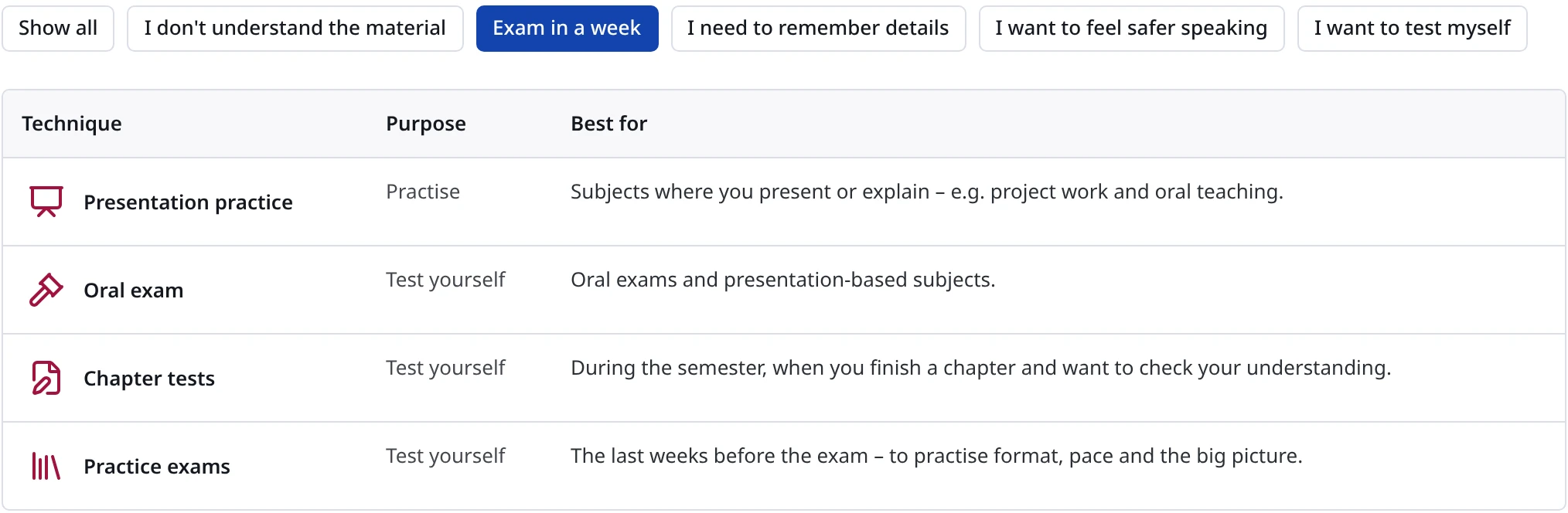
Now one priority comes before all others: practise what the exam actually measures. That means writing answers under time pressure, explaining the material out loud and checking that you have covered every topic, including the ones you would rather avoid. The study guide in Aria shows which techniques fit best when the exam is just around the corner.
Doing things right
- Rereading the syllabus from page one, just to be safe.
- Rewriting and colour coding notes so they look tidy.
- Spending most of the time on the topics you already enjoy.
Doing the right things
- Taking a practice exam early in the week to see where you stand.
- Practising the weakest topics in a targeted way, in writing and out loud.
- Making sure every topic is practised at least twice.
How the Exam Pack follows the same principle
This is exactly what the Exam Pack in Aria is built for. When time is too short for a regular reading plan, you gather your syllabus in the subject, and Aria sorts it into topics and subtopics. The pack contains no reading sessions; it consists of practice in two or three rounds, spread out towards your exam date.
- The first round maps your knowledge: chapter tests, quizzes and Socratic dialogues on each topic show what sticks and what is missing.
- The second round is about application, for example case training, deep dives and explaining the material simply with the Feynman technique.
- The third round drills the exam format, with an oral exam and a practice exam as a dress rehearsal.
Before the pack is saved, Aria checks that every topic and subtopic has at least two sessions, so no part of the syllabus is skipped. Your progress is shown in the same mastery overview as in the study plan.
How to prioritise when time is short
Whether you use Aria or not, you can ask yourself one question before every session: does this resemble what I will do in the exam? If the answer is no, the activity should wait until after the exam.
- Write down every topic in the syllabus, so you can see the full scope.
- Test yourself briefly on each topic and mark the weakest ones.
- Spend most of your time on the weak topics, but go through all of them at least twice.
- Finish with a timed practice exam, and use the result for final adjustments.
Do this now
- Before each session, ask whether the activity resembles what the exam requires.
- Drop new reading and rewriting in the final weeks.
- Practise every topic at least twice, with extra time on the weak ones.
- Take a timed practice exam as a dress rehearsal before the exam.
Frequently asked questions
Is it too late to start practising one week before the exam?
No. Little time is an argument for practising, not for reading more. A week of targeted testing on every topic gives you a clearer picture of what you know than a week of rereading.
Should I stop reading completely during exam season?
Look things up in the syllabus when a test reveals a gap, but let practice steer your reading. Read to close a specific gap, not from start to finish.
What is the difference between a study plan and the Exam Pack in Aria?
A study plan spreads both reading and practice across the whole semester. The Exam Pack is made for the final stretch and consists only of practice, divided into two or three rounds that cover every topic.
Sources
Create your first Exam Pack
Gather the syllabus in your subject and get a ready-made practice path that covers every topic twice. Try Aria free for 7 days.
Start 7 days free